
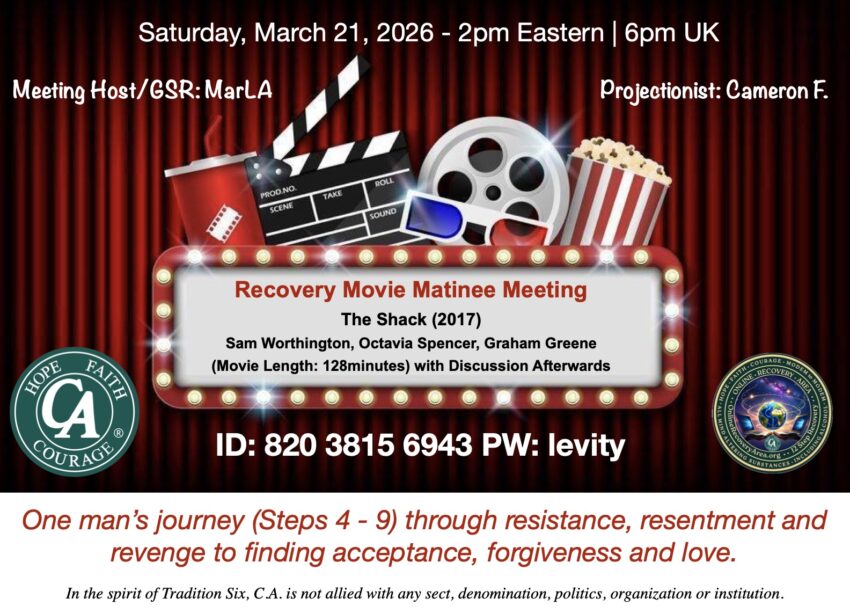
The Shack, directed by Stuart Hazeldine and based on the novel by William P. Young, is a deeply emotional story of grief, faith, and forgiveness. Starring Sam Worthington, Octavia Spencer, and Tim McGraw, the film follows Mack, a devoted husband and father whose life is shattered after the tragic loss of his young daughter. Consumed by grief and resentment, Mack receives a mysterious invitation to return to the shack where his daughter’s body was found, setting the stage for a transformative encounter with God.
From a recovery perspective, Mack embodies the untreated addict; not necessarily in substance use, but in the way he is powerless over grief, living in remorse, regret, and morbid reflection. His wife’s plea, “I don’t want to lose you too,” echoes the impact our spiritual sickness has on those around us. Though outwardly functioning, Mack is internally cut off, blocked by self-pity and resentment, especially toward God. As the Big Book reminds us, resentment is “the number one offender,” (AA, p. 64) and we watch Mack build a case against God, replaying the past and demanding answers.
At the shack, Mack encounters a man who leads him out of a cold wintery world into a lush summer setting with a cabin nestled in the forest. There he meets three people, the symbolic representation of the Father, Son and Holy Spirit. Mack reluctantly begins a mysterious relationship with a power greater than himself. Octvaia Spencer, playing God, delivers many insights; “When all you see is your pain, you lose sight of me.” This speaks directly to our experience as addicts, our pain narrows our vision, keeping us locked in self-centeredness. The film reinforces Step Three: “First of all, we had to quit playing God. It didn’t work.” (AA, p. 62). Mack is confronted with his need to judge his daughter’s killer, his past and even God but he comes to see that he is not qualified to judge, “I don’t want to be the judge anymore,” he eventually admits. This reflects the willingness of Step Six.
God’s message that “I don’t punish people, sin is its own punishment” aligns with our experience of defects of character. Fear, resentment, selfishness, these are true sources of suffering from which we seek relief by picking up our drug of choice again and again until we are brought into the real solution. Mack is invited into trust. Graham Greene plays God in one of the most poignant scenes which is featured monthly at our 12 Steps in 4 Hours workshop, “I’m not asking you to forgive what he did, I’m asking you to trust me.” God tells Mack who is facing his own Step 9 experience. Similarly, many of us recovering addicts have suffered major traumas and it is truly challenging to forgive those who harmed us. Through working the 12 steps we experience “God is doing for us what we could not do for ourselves” (AA, p. 84). Like Mack, we can make the shift from self-reliance to reliance on a Higher Power.
By the end, Mack experiences a release from resentment and bitterness. He encounters the spiritual principles that can solve all our problems (AA, p. 42) and he is able to forgive (Steps 8 & 9). In recovery terms, he begins to know “a new freedom and a new happiness” (AA, p. 83), carrying the message not through words, but through how he lives.
If you haven’t seen The Shack, I highly recommend it! It is a truly touching film that is full of beauty and the transformative power of developing a relationship with a God of one’s own understanding. Thank you all who joined us for this heartwarming screening, we were able to normalize crying as each of us bawled our guts out in the loving spirit of fellowship.
Review by MarLa B.